Definition
An Agent Control Plane is the system of record and enforcement layer for AI agents in an organization. It knows which agents exist, who owns each one, what each is allowed to reach, and what each actually did. It applies the same governance discipline organizations already use for people (request, approve, review, revoke) to software that acts on its own.
Why it is needed now
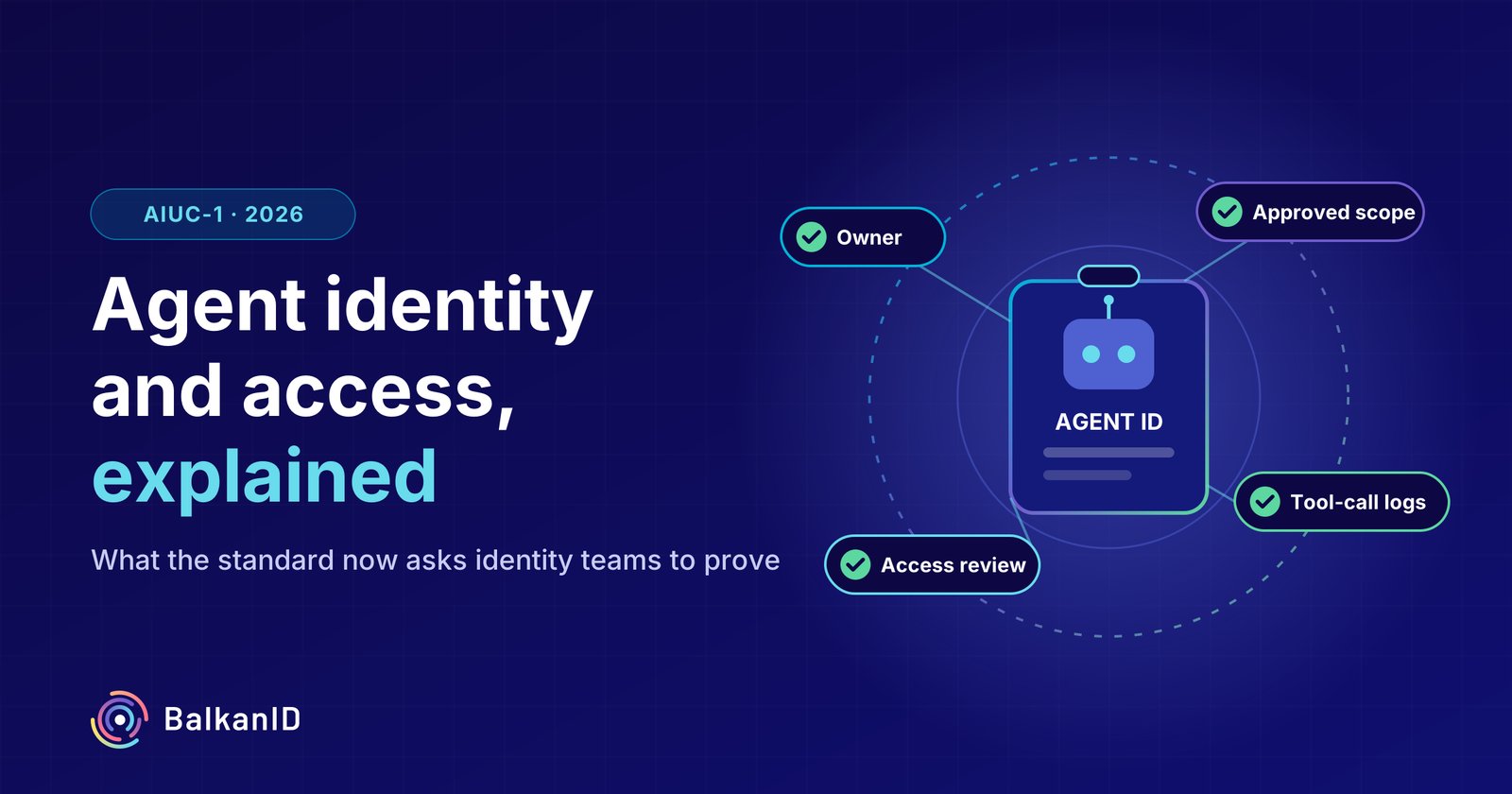
AI agents are no longer chat windows. They call tools, read data and take actions through APIs and MCP servers, often with credentials borrowed from a person or a shared service account. That creates three problems identity teams already recognize: access nobody approved, access nobody owns, and actions nobody can attribute. Standards such as AIUC-1 now expect each agent to have its own identity and scoped access, which shared keys cannot provide.
The five components
- Discovery and register. Find agents and MCP servers across clouds, SaaS and developer tools, and record each one in an identity register.
- Ownership and purpose. Every agent has an accountable human owner and a stated purpose, the same way a service account should.
- Approved scope. Agents get access through a request and approval, limited to the tools and data their purpose needs, and time-bound where possible.
- Runtime policy. Tool calls are checked against that scope while the agent runs, with high-risk actions routed to a human.
- Review and evidence. Agent access goes into the same certification campaigns as human and non-human access, with a full audit trail.
How it differs from related tools
- AI gateway: which model calls and prompts are allowed through?
- Secrets vault: where are the credentials stored and rotated?
- Identity provider: can this agent authenticate?
- Agent Control Plane: should this agent have this access, who owns it, and what did it do?
These work together. A control plane usually reads from the identity provider and vault and can feed policy to a gateway.
Questions to ask when evaluating one
- Does it discover agents you did not register yourself?
- Can it tie every agent to an owner and remove access when the owner leaves?
- Does it govern agents, service accounts and people in the same review process?
- Can it cover MCP servers and agents across vendors, not only one platform?
- Does it produce evidence mapped to AIUC-1, the EU AI Act and SOC 2?
For a side-by-side look at the market, see the AI agent governance tools buyer's guide, and for MCP specifics, how to govern MCP servers.
How BalkanID approaches it
The BalkanID Agent Control Plane sits on the same access graph as BalkanID IGA and PAM, so an agent's access is reviewed next to the people and service accounts it acts for. It works whether BalkanID is your IGA or runs alongside SailPoint, Okta or another platform.
Sources: Cloud Security Alliance research note on AIUC-1 Q2 2026.