AIUC-1 made agent identity an identity problem
AIUC-1 is a certification standard for AI agents, organized into six areas: data and privacy, security, safety, reliability, accountability and society. Across those areas it sets out roughly 51 requirements and 130 controls. For most of its short life it read like an AI safety framework. The Q2 2026 update changed that for identity teams.
What changed in Q2 2026
The update, effective April 15, 2026, split agent identity and access into its own domains, added controls for MCP and agent-to-agent (A2A) connections, extended validation to every tool call including calls to third-party MCP servers, and made monitoring of third-party access mandatory. The practical reading: an agent running on a shared service account or an ambient API key will not meet the standard. The Q3 update in July focused on coding agents.
What auditors will ask for
- A register of agents, each with its own identity
- An accountable owner and documented purpose for each agent
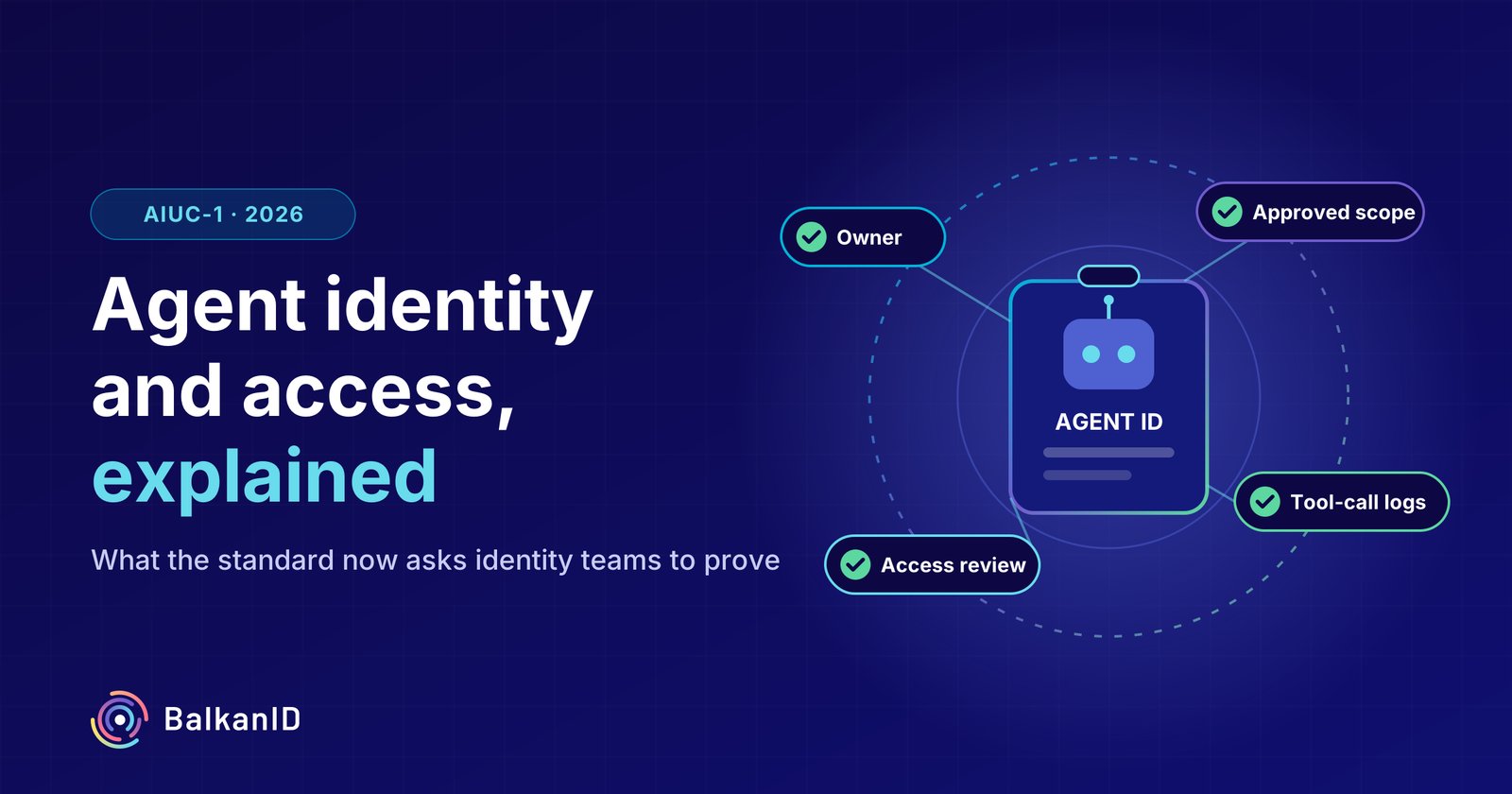
- Evidence that each agent's access was approved and is limited to what it needs
- Logs that tie each tool call to an agent and, where relevant, the person it acted for
- Periodic review of agent access, and removal when it is no longer needed
Certificates last 12 months, with technical testing every three months, so this is ongoing work rather than a one-time project.
A 30-60-90 plan
First 30 days: inventory agents and MCP servers, and find which ones run on shared credentials.
By day 60: assign owners, give each agent its own identity, and move access to request and approval.
By day 90: put agent access into your quarterly reviews and turn on tool-call logging tied to agent identity.
Where BalkanID fits
The BalkanID Agent Control Plane covers the register, ownership, approved scope, runtime policy and reviews, and keeps agent access in the same evidence trail as your human and non-human access. Teams can start with a complimentary, read-only identity and agent risk assessment that maps their gaps to AIUC-1.
Sources: Cloud Security Alliance research note on AIUC-1 Q2 2026; Wipfli overview of AIUC-1.