Oops! Something went wrong while submitting the form.
Cookies on this website
By clicking “Accept”, you agree to the storing of cookies on your device to enhance site navigation, analyze site usage, and assist in our marketing efforts. View our Privacy Policy for more information.
Discover why Identity Visibility and Intelligence Platforms (IVIP) are replacing legacy IGA. Learn how to manage NHIs, Agentic AI, and ISPM to secure the modern identity fabric.
BalkanID Launches Complimentary Identity Risk and Compliance Assessment Covering Human, Non Human, and AI Agent Identities
One-time, no-cost ISPM analysis gives security, IT and compliance leaders a unified, data driven view of IAM risk, RBAC effectiveness, AI and non human identity governance, and audit readiness across every major framework.
From Fragmented Identity to Unified Intelligence: Visualizing the BalkanID Access Graph
BalkanID introduces a unified visualization layer for identity based on the identity access graph. It provides a single, connected view of access across human, service, and AI identities across all environments, bringing together data from existing IAM tools to help teams clearly see how access is structured and connected across the organization.
Discover why Identity Visibility and Intelligence Platforms (IVIP) are replacing legacy IGA. Learn how to manage NHIs, Agentic AI, and ISPM to secure the modern identity fabric.
Introduction: The Identity Crisis of 2025
If there’s one consistent theme I hear from CISOs and IAM architects today, it’s this: we don’t just have an access problem - we have a visibility problem.
Security teams still struggle to answer basic questions:
Who actually has access today?
What is over-privileged?
Which identities and accesses pose real risk right now?
Most organizations aren’t lacking IAM tools. They’re drowning in them. SSO, IGA, PAM, cloud-native IAM, SaaS admin consoles - each solving a narrow slice of the problem, none providing a complete picture. The result is identity sprawl: fragmented identities, fragmented permissions, and fragmented risk ownership.
This is the identity crisis of 2025. Not a lack of controls, but a lack of coherent visibility across controls.
This is why it’s not surprising to see Identity Visibility and Intelligence Platforms (IVIP) emerge in the Gartner 2025 Hype Cycle for Digital Identity. IVIP is not “yet another identity tool.” It is the connective tissue that binds the modern identity fabric together.
The shift underway is fundamental. We are moving from managing access to governing identity posture and risk - continuously.
What Is an Identity Visibility and Intelligence Platform (IVIP)?
Definition
An Identity Visibility and Intelligence Platform (IVIP) is a unifying intelligence layer that continuously aggregates, normalizes, and analyzes identity data across siloed systems - HRIS, IGA, PAM, cloud infrastructure, and SaaS - to provide a single, actionable view of identity risk and posture.
Traditional identity systems answer narrow questions: Can this user log in? Was access approved?
IVIP answers broader, more relevant ones: Should this identity still have this access? How risky is it? What is the blast radius if it’s compromised?
In simple terms: IVIP tells you who or what has access, why they have it, how risky it is, and what to do next.
Breaking it Down
IVIP achieves this through two tightly coupled capabilities.
Visibility
Continuous discovery of human and non-human identities
Correlation across accounts, entitlements, credentials, and resources
Coverage across on-prem, cloud, and SaaS
Intelligence
AI-driven prioritization of which over-privileged identities actually matter
Contextual risk scoring based on usage, sensitivity, and blast radius
Detection of toxic permission combinations and entitlement drift
IVIP vs. Legacy IGA
Traditional IGA was designed for a slower world:
Snapshot-based certifications
Static roles
Quarterly or annual reviews
Traditional IGA (Static)
Modern IVIP (Fluid)
Snapshot / Point-in-time
Continuous / Real-time
Human-centric
Human + Non-Human + Agentic AI
Compliance-driven
Risk & Posture-driven
Manual Spreadsheets
AI-Driven Automation
In a cloud and SaaS-first environment, point-in-time governance is no longer governance—it’s theater. IVIP is continuous, because modern infrastructure is continuous.
The Four Pillars of IVIP (Why It Matters Now)
IVIP is not an abstract concept. It is a response to four real shifts happening simultaneously.
Solving the Machine & Non-Human Identity (NHI) Gap
In most enterprises today, non-human identities outnumber humans by 40 to 1. Service accounts, bots, API keys, OAuth tokens, certificates - these identities run critical workloads, yet often lack ownership, lifecycle controls, or visibility. Legacy IGA largely ignores them.
Most legacy IGA tools:
Don’t discover NHIs automatically
Don’t track ownership
Don’t govern lifecycle or usage of NHI
This creates massive machine identity visibility gaps, where the most powerful identities in the environment are the least governed. IVIP treats non-human identities as first-class citizens. They are discoverable, attributable and governable using the same rigor applied to people.
Agentic AI Identity Security
The next wave of identity risk won’t come from humans. It will come from agentic AI.
AI agents are beginning to act autonomously: provisioning resources, calling APIs, modifying infrastructure, and making decisions without direct human intervention. These agents operate using transient, high-privilege credentials that bypass traditional SSO and review workflows.
Without visibility, these identities become invisible administrators.
Agentic AI identity security requires continuous discovery, monitoring, and governance of machine-driven access.
IVIP provides the foundation to discover, monitor, and govern these identities before they become systemic risk.
Identity Security Posture Management (ISPM)
Visibility enables posture. This is where Identity Security Posture Management (ISPM) fits.
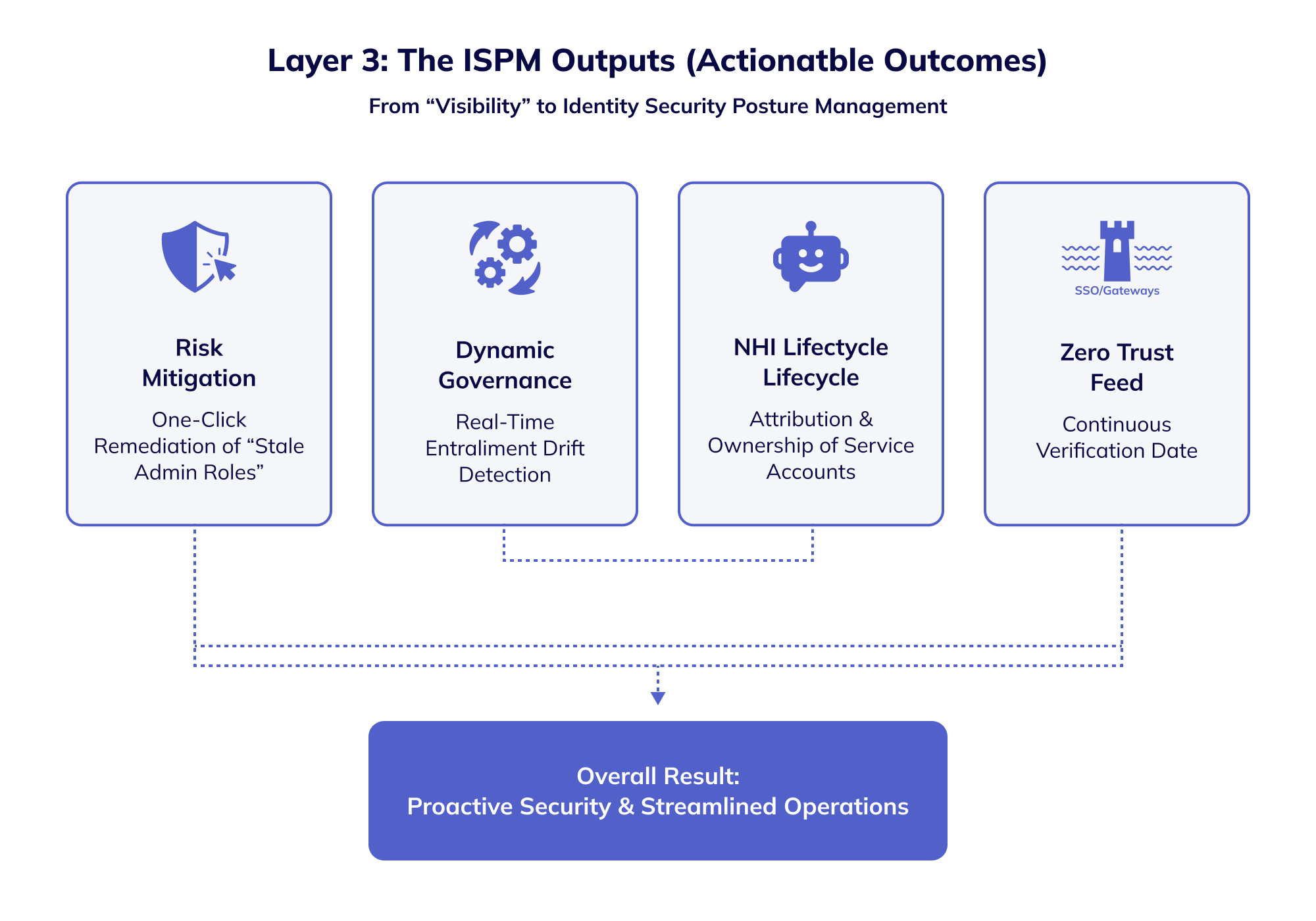
ISPM is the ongoing discipline of identifying and reducing identity risk—detecting toxic permission combinations, stale access, excessive privileges, and weak controls. IVIP supplies the data; ISPM turns it into sustained improvement.
Instead of reacting to incidents or audits, organizations can measure identity posture continuously and improve it proactively. This is a critical shift from compliance theater to real security outcomes.
Acting as the Intelligence Layer of the Identity Fabric
An identity fabric is not a single product. It’s an architecture. Okta, Entra, AWS, Azure, Workday, and SaaS apps all play roles, but none provide intelligence across the whole.
Without IVIP, these systems remain loosely integrated silos.
IVIP becomes the connective tissue that correlates identities, permissions, and policies across these systems. With it, policy, posture, and risk become consistent across the enterprise - identity governance becomes coherent.
Deep Dive: Bridging the Visibility Gap in Cloud & SaaS
Cloud and SaaS environments expose the limits of traditional IAM thinking.
Each cloud platform has its own identity model. AWS IAM does not understand Azure roles. SaaS admin privileges often bypass SSO entirely. Effective permissions are distributed across dozens of control planes.
This creates a dangerous illusion of control.
Even worse, identity data degrades over time. Orphaned accounts persist. Admin tokens are never rotated. Temporary exceptions become permanent. This “bad identity data” quietly accumulates risk.
A common example: a stale AWS admin role created for a migration, left outside SSO, with MFA disabled. No alerts fire. No review catches it.
Native tools won’t flag this. Only a platform with continuous, cross-system visibility can detect it. An IVIP will detect this, because it correlates identity, entitlement, usage as, and risk context.
From Visibility to Action: The BalkanID Approach
Visibility alone is not enough. Visibility without action is just another dashboard. Intelligence must drive action.
At BalkanID, IVIP is designed to move directly from understanding risk to reducing it. Identity context matters—permissions alone are meaningless without understanding usage, sensitivity, and blast radius.
That intelligence feeds directly into action:
Risk-based, automated access reviews that replace spreadsheets
One-click remediation to remove or downgrade access
AI-driven role mining and anomaly detection to prevent future sprawl
The goal is not to create more alerts, but to close the loop between insight and enforcement.
Why the Board Cares
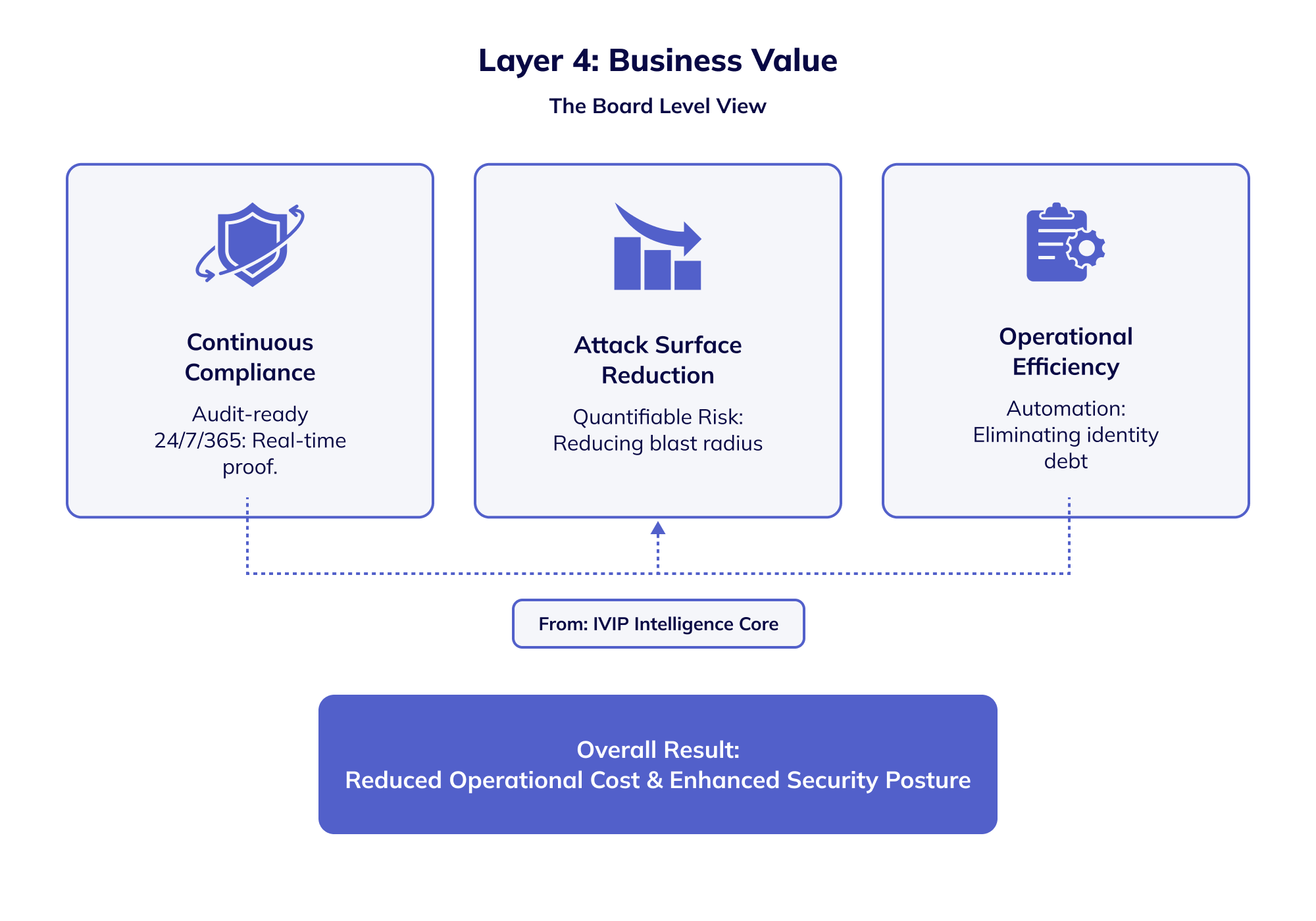
Identity is now a board-level risk because it underpins every breach scenario.
IVIP enables:
Continuous compliance, instead of episodic audits
Quantifiable risk reduction, measured in reduced attack surface
Operational efficiency, by eliminating identity debt created by manual processes
This reframes identity governance from an IT cost center into a measurable security control.
Conclusion: The Future of Identity Is Intelligent
Identity Visibility and Intelligence Platforms represent the next evolution of identity governance. They complete the identity fabric by adding the intelligence layer that legacy IAM never had.
The future of identity is not more tools, more reviews, or more alerts. It is continuous visibility, contextual intelligence, and automated action - all working together.
IVIP is how modern organizations get there.
At BalkanID, we are building IVIP as a living system - one that continuously understands identity posture and acts on it.
Frequently Asked Questions (FAQ)
What is an Identity Visibility and Intelligence Platform (IVIP)?
An IVIP unifies fragmented IAM data into a single view of identity posture, activity, and relationships. It forms the intelligence core of a modern identity fabric.
What is Identity Security Posture Management (ISPM)?
ISPM is the continuous process of identifying and remediating identity risks, such as toxic permissions or stale access, enabled by the visibility provided by IVIP.
How does an Identity Fabric differ from traditional IAM?
Traditional IAM tools are siloed. An identity fabric is a connected architecture where IVIP ensures consistent policy enforcement and risk visibility across all systems.
Why is Identity Visibility important for Multi-Cloud environments?
Cloud-native IAM tools don’t talk to each other. IVIP closes this visibility gap by showing effective permissions across all clouds and SaaS platforms.
What are the benefits of governed Non-Human Identities (NHI)?
Governed NHIs eliminate shadow access, reduce breach risk, and apply lifecycle controls to service accounts and API keys.
What problems does an Identity Fabric help solve?
It addresses identity sprawl, reduces blast radius from compromised accounts, and automates error-prone manual reviews.
What is Agentic AI Identity Security?
It is the governance of autonomous AI agents, ensuring their permissions don’t expand unchecked through entitlement creep.
What is the difference between IVIP and traditional IGA?
IGA provisions access. IVIP governs identity posture and risk in real time.
How do you identify Toxic Permission Combinations?
By correlating entitlements, security controls, and usage, such as production delete rights combined with no MFA.
Can IVIP help with Zero Trust?
Yes. Zero Trust requires continuous verification, and IVIP provides the identity visibility needed to enforce it.
.svg)