From Vaults to Intent: The Evolution of PAM from 1.0 to JIT to JITPBAC
Trace the evolution of privileged access management, from static credential vaults to intent-driven, just-in-time access models.
.svg)


Trace the evolution of privileged access management, from static credential vaults to intent-driven, just-in-time access models.
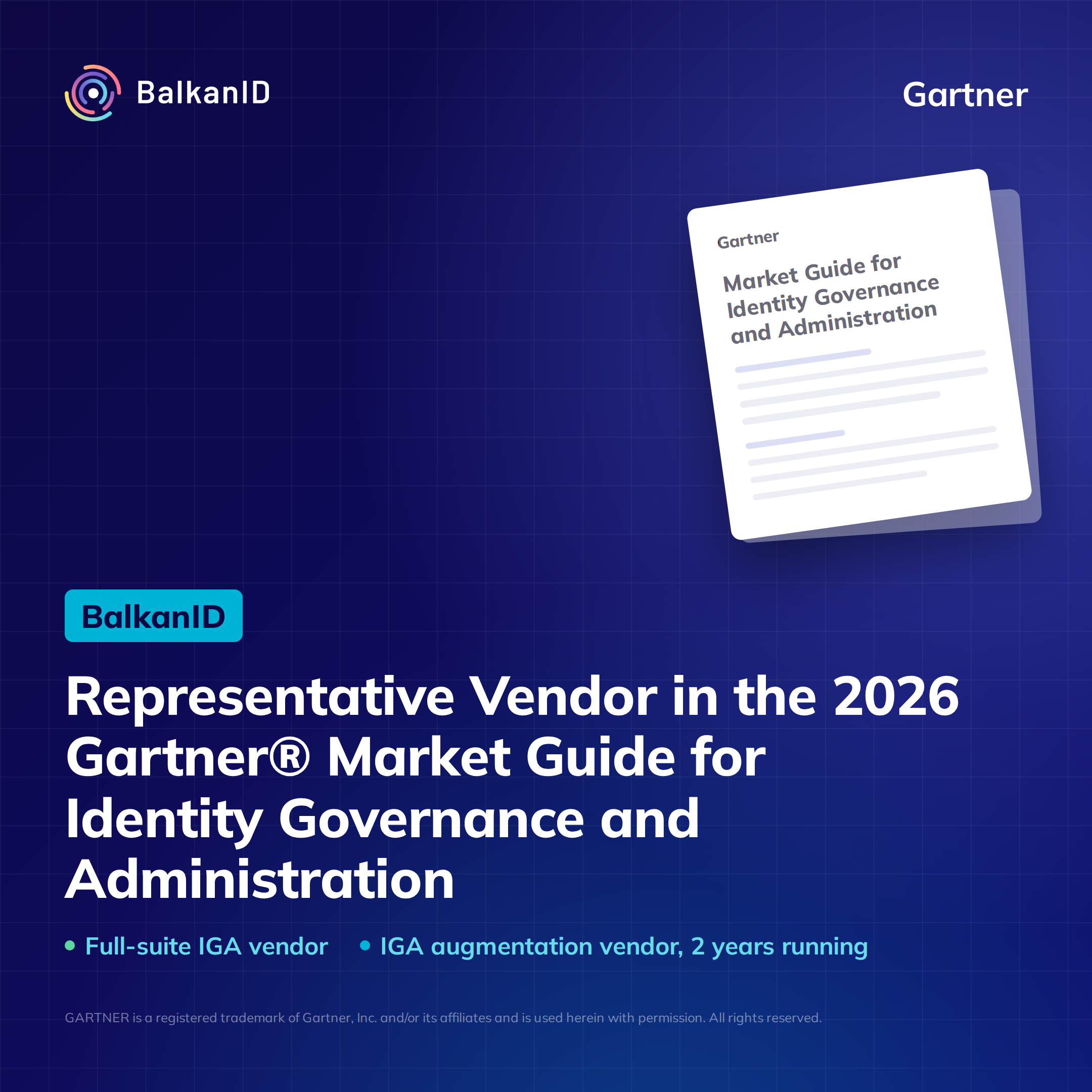
BalkanID is listed among full-suite IGA vendors in the Market Guide. Separately, Gartner Innovation Insight research continues to name BalkanID an IGA augmentation vendor for the second year in a row.

BalkanID is listed among full-suite IGA vendors in the Market Guide. Separately, Gartner Innovation Insight research continues to name BalkanID an IGA augmentation vendor for the second year in a row.

One-time, no-cost ISPM analysis gives security, IT and compliance leaders a unified, data driven view of IAM risk, RBAC effectiveness, AI and non human identity governance, and audit readiness across every major framework.
One-time, no-cost ISPM analysis gives security, IT and compliance leaders a unified, data driven view of IAM risk, RBAC effectiveness, AI and non human identity governance, and audit readiness across every major framework.



Trace the evolution of privileged access management, from static credential vaults to intent-driven, just-in-time access models.

Privileged Access Management didn’t start as a strategic discipline. It started as damage control.
In the early days of enterprise IT, privileged credentials were static, shared, and rarely audited. Root passwords lived in spreadsheets. Admin accounts were passed around teams. When breaches happened, the response was predictable: lock the credentials down.
That response gave birth to PAM 1.0.
But as infrastructure, cloud, and automation evolved, the original PAM model began to crack. Today’s environments move too fast, and privileged access is too frequent, for static controls to keep up.
This pressure has driven the industry into evolving PAM accordingly - not once, but twice.
PAM 1.0 emerged to solve a narrow but critical set of issues:
The solution was equally focused:
From a security standpoint, this was a breakthrough. It dramatically reduced credential sprawl and introduced accountability where none existed before.
PAM 1.0 was built on an assumption that quietly shaped everything:
Privileged users are rare, long-lived, and exceptional.
In a world of static infrastructure and centralized IT teams, that assumption held.
It does not hold anymore.
As organizations moved to cloud platforms and DevOps operating models, privileged access stopped being exceptional.
Developers needed admin rights to deploy infrastructure. SREs needed elevated access to troubleshoot production. Pipelines required service accounts with powerful permissions.
From a CIO’s perspective, PAM became friction:
From a CISO’s perspective, PAM became risky:
The problem wasn’t that PAM was too strict. It was that static privilege models no longer matched dynamic systems.
PAM 2.0 emerged as a correction, not a replacement.
The core insight was simple:
Privileged access should exist only when it is actively needed—and disappear immediately afterward.
This is Just-In-Time (JIT) privileged access.
Instead of assigning standing admin rights, PAM 2.0 introduced:
The vault still exists. Credentials are still protected.
But access to them is no longer permanent.
This shift reframed PAM’s core goal:
JIT aligned PAM with modern reality:
JIT reduced time-at-risk without grinding operations to a halt. For many organizations, this felt like the end state. It wasn’t.
As JIT adoption increased, a deeper issue surfaced—one that neither PAM 1.0 nor PAM 2.0 could fully address.
JIT answers:
It does not answer:
In practice, JIT often devolves into:
Standing privilege was replaced with standing intent, just sliced into smaller windows.
This is where PAM reaches its next inflection point.
The next evolution of PAM is not about shorter time windows. It’s about intent-aware access.
Just-In-Time Purpose-Based Access Control (JITPBAC) extends JIT by binding privilege not just to time, but to purpose.
Access is no longer granted simply because:
Access is granted because:
This introduces a new question into PAM decisions:
Does this access make sense in context?
From a CISO’s perspective:
From a CIO’s perspective:
JITPBAC doesn’t slow the business. It removes ambiguity.
JITPBAC exposes a fundamental truth:
Purpose cannot be inferred from PAM alone.
Understanding who should be eligible, why access exists, and when it should be revoked requires:
This is why modern PAM is converging with identity governance and lifecycle orchestration - not at the tool level, but at the control-plane level.
PAM enforces. Identity systems decide. Purpose binds the two.
The evolution of PAM tells a clear story:
Each phase didn’t replace the last, it corrected its blind spots.
Vaults were necessary. Just-in-time access was transformative. Purpose-based control is inevitable.
The current mode of privileged access is not about who has admin rights. It’s about why access exists at all and proving that answer continuously. That is PAM 3.0 or JITPBAC.
BalkanID is listed among full-suite IGA vendors in the Market Guide. Separately, Gartner Innovation Insight research continues to name BalkanID an IGA augmentation vendor for the second year in a row.
BalkanID is listed among full-suite IGA vendors in the Market Guide. Separately, Gartner Innovation Insight research continues to name BalkanID an IGA augmentation vendor for the second year in a row.
One-time, no-cost ISPM analysis gives security, IT and compliance leaders a unified, data driven view of IAM risk, RBAC effectiveness, AI and non human identity governance, and audit readiness across every major framework.
One-time, no-cost ISPM analysis gives security, IT and compliance leaders a unified, data driven view of IAM risk, RBAC effectiveness, AI and non human identity governance, and audit readiness across every major framework.