Cookie Preferences

When you visit websites, they may store or retrieve data in your browser. This storage is often necessary for the basic functionality of the website.

Accept All Cookies
Close
Cookies on this website

By clicking “Accept”, you agree to the storing of cookies on your device to enhance site navigation, analyze site usage, and assist in our marketing efforts. View our Privacy Policy for more information.

Veza Alternatives

The Best Veza Alternatives & Competitors for 2026

BalkanID Logo Icon
User Access ReviewsWhen and WhyTop ToolsScalabilityRecommendationsFAQs

Introduction:

  • The "Veza Complexity" Narrative: Veza is a powerhouse for "Identity Security Posture Management" (ISPM), but for many organizations, its deep focus on data-level permissions (like Snowflake or AWS S3) can be overkill.
  • The Goal: If you are looking for a solution that combines the depth of an "Access Graph" with the simplicity of automated compliance and transparent pricing, there are several modern alternatives to consider.

Comparison Table: Veza vs. Modern Competitors (2026)

Feature
BalkanID
Veza
ConductorOne
Varonis
Primary Value
Risk-First Compliance
Deep Data Visibility
Access Requests/JIT
Data Security (DSPM)
Best Feature
AI Identity Copilot
The Access Graph
Slack-based Workflows
Blast Radius Analysis
Pricing
Transparent/Public
Hidden/High-End
Hidden/Modular
Hidden/Very High
Setup Speed
Very Fast (Days)
Slow (Weeks/Months)
Moderate (Weeks)
Slow (Heavyweight)
Non-Human IDs
Yes
Advanced
Moderate
Basic
Ideal For
Audit-Ready Security
Enterprise Data Clouds
Developer Teams
Regulated Data

1. BalkanID:

The High-Intelligence, Low-Barrier IGA Alternative
Overview

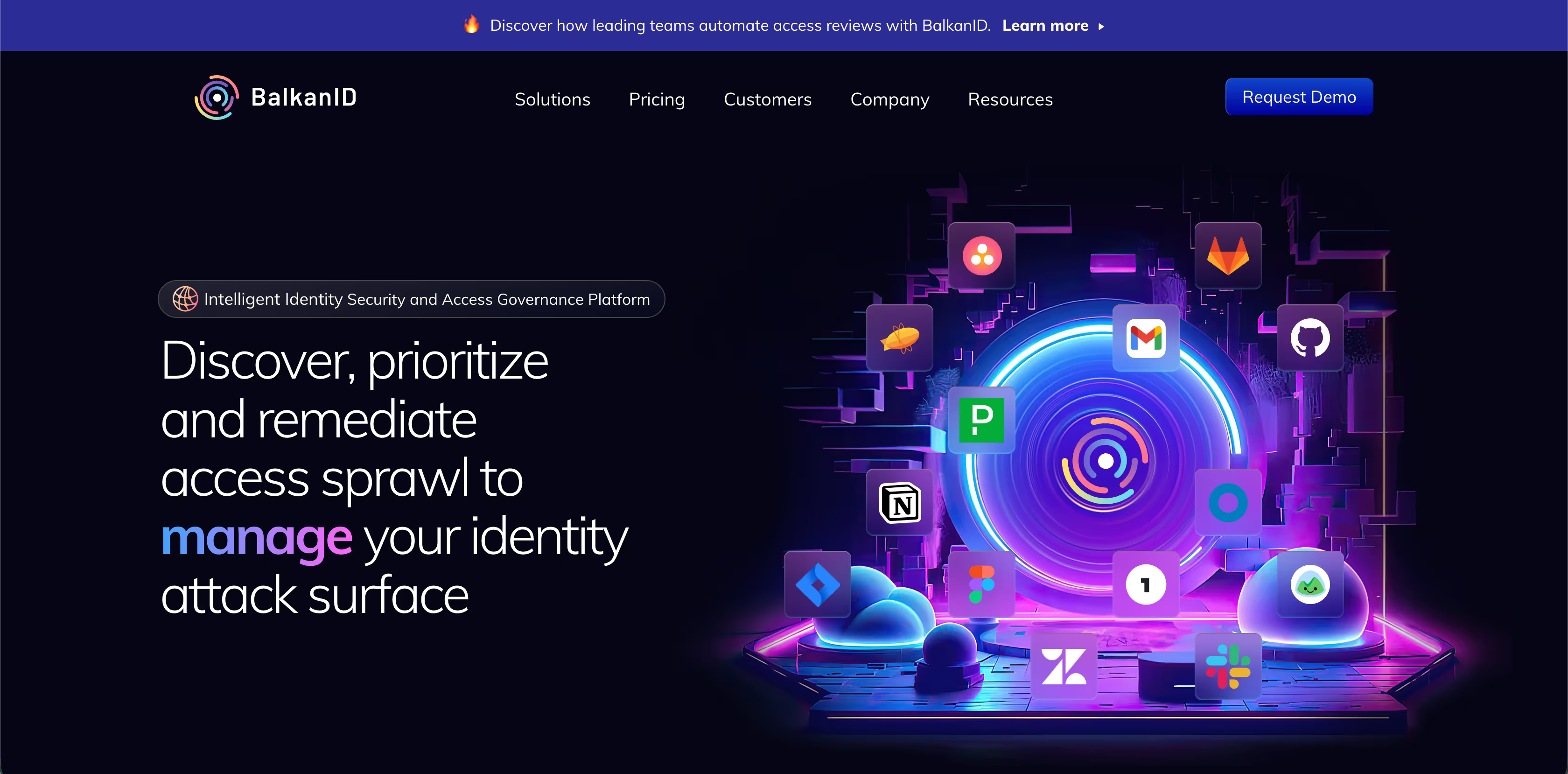
BalkanID is built for organizations that need true identity governance without enterprise friction. Positioned as the first Intelligent IGA, BalkanID focuses on identifying, explaining, and remediating risky entitlements across SaaS, cloud, and on-prem environments—bridging the gap between basic access management tools and heavyweight identity security platforms like Veza.

Rather than modeling access for its own sake, BalkanID is designed to help security and compliance teams make faster, higher-confidence access decisions.

Strengths

  • Transparent, Accessible Pricing: BalkanID is the only IGA platform offering publicly available, self-service pricing. BalkanID Lite starts at $1k/month, lowering the barrier for mid-market and scaling enterprises.
  • Risk-Based Access Reviews: Uses peer analysis, role context, and entitlement correlation to explain why access is risky—not just that it exists—improving reviewer accuracy and audit outcomes.
  • Audit-Ready by Design: Purpose-built for SOC 2, SOX, ISO 27001, and similar frameworks, with automated evidence generation and reviewer traceability.
  • AI-First User Experience: Identity Copilot enables natural-language exploration of access, risk, and remediation paths, reducing dependency on identity experts.
  • Focused IGA Depth: Prioritizes access correctness, SoD risk, and entitlement hygiene over SaaS inventory or spend management.

Weaknesses

  • Less data-layer depth than Veza: While BalkanID covers AWS, Azure, GCP, SaaS, and on-prem systems, it does not currently go as deep into table-level or row-level database permissions as Veza.

Ideal Customer

Security and Compliance teams (SMB to Enterprise) that:
  • Need to solve access reviews and audit readiness quickly
  • Want risk-driven governance, not just visibility
  • Value pricing transparency and fast deployment
  • Prefer a modern, explainable IGA experience

Pricing

  • BalkanID Lite: $1,000/month
  • Enterprise: Transparent, scalable tiers starting at $25,000/year
  • optional managed services

2. Veza (The Baseline)

Overview

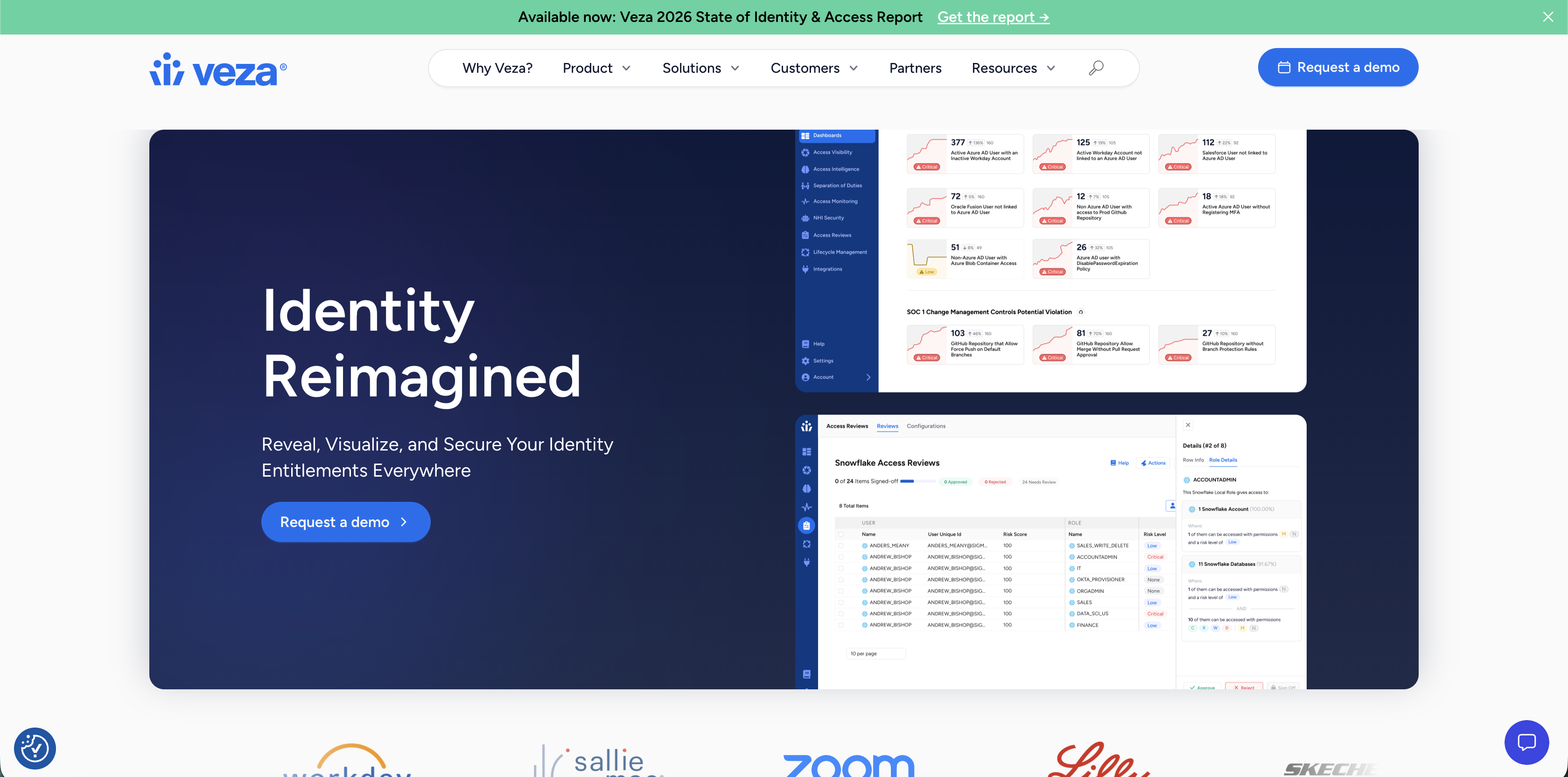
Veza positions itself as “the authorization platform for data”, built to help large enterprises understand effective permissions across cloud, SaaS, and data systems. At the core of the platform is Veza’s Access Graph, which models the relationships between identities (human and non-human), resources, and permissions.

Veza excels in environments where data access complexity and scale demand extremely granular visibility.

Strengths

  • Unmatched Authorization Depth: Industry-leading visibility into effective permissions, including fine-grained actions inside systems like Snowflake, Databricks, and cloud IAM.
  • Strong Non-Human Identity Coverage: Robust support for service accounts, workloads, and machine identities.
  • Access Graph Foundation: A powerful data model that supports access search, analytics, governance, and automation.
  • Enterprise Extensibility: Open Authorization API (OAA), APIs, webhooks, and SCIM enable deep customization for complex environments.
  • ISPM Leadership: Recognized as a leader in Identity Security Posture Management (ISPM).

Weaknesses

  • High Total Cost of Ownership: Pricing is opaque and typically starts at $50k–$100k+ annually, often increasing with scale and customization.
  • Operational Complexity: Requires significant configuration, tuning, and expertise to operationalize at scale.
  • Less reviewer-friendly UX: Optimized for security engineers more than business reviewers or audit participants.

Ideal Customer

Large enterprises with:

  • Massive cloud and data estates
  • Complex authorization models
  • Dedicated identity and cloud security engineering teams
  • Budget and resources to support a high-touch platform

Pricing

  • Quote-based only
  • Typically six-figure annual commitments

3. ConductorOne

Overview

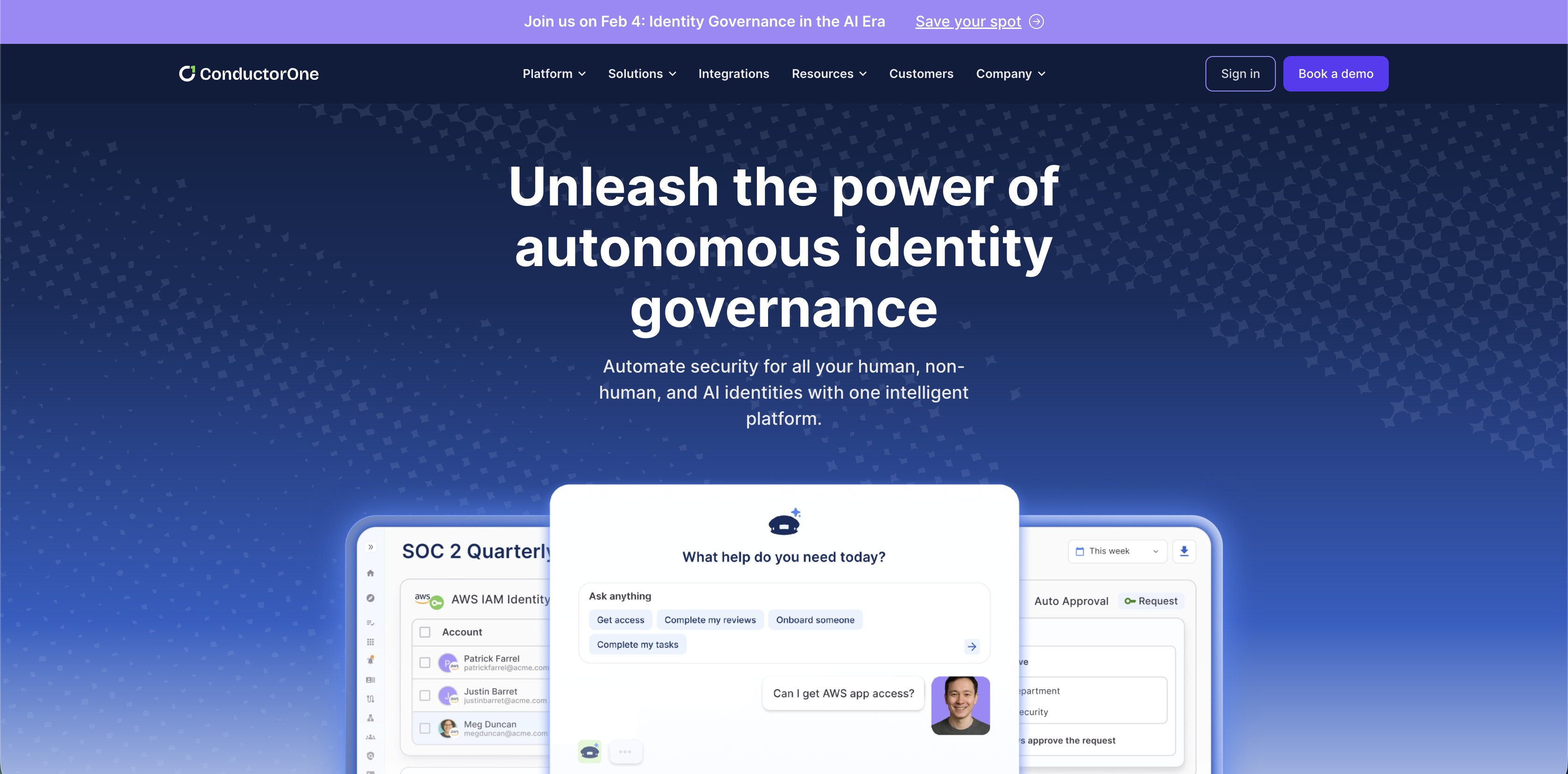
ConductorOne is an AI-native identity security platform built for large organizations managing the rapid growth of human, non-human, and AI identities across cloud and on-prem systems. Its core mission is to minimize the number of identity tasks humans need to touch, using automation, policy, and orchestration.

The platform emphasizes access requests, lifecycle automation, and just-in-time access, with governance embedded into operational workflows.

Strengths

  • Strong Lifecycle Automation: Automated joiner-mover-leaver (JML), dynamic access control, and attribute-based provisioning/deprovisioning across SaaS, cloud, and on-prem systems.
  • Unified Identity Graph: Centralized visibility across identities, permissions, and systems.
  • Identity Automation: Robust automation builder with support for Terraform, APIs, webhooks, and custom workflows.
  • Enterprise-Grade Integrations: Broad support for managed and self-hosted connectors, enabling hybrid and custom environments.
  • Copilot-Driven Insights: Identity Security Posture Management (ISPM) with AI-assisted insights.

Weaknesses

  • Access reviews are not risk-first: Reviews focus more on workflow execution than on deep entitlement risk analysis or prioritization.
  • Pricing opacity: No public pricing; entry point is typically $14k+ annually, scaling with usage and modules.
  • Limited managed services: Public documentation does not indicate full operation of governance programs as a managed service.

Ideal Customer

Large, high-growth enterprises that:

  • Want to automate identity operations at scale
  • Have strong DevOps or platform engineering maturity
  • Need centralized identity control across complex environments

Pricing

  • Quote-based
  • Typically enterprise-focused pricing tiers

4. Zilla Security

Overview

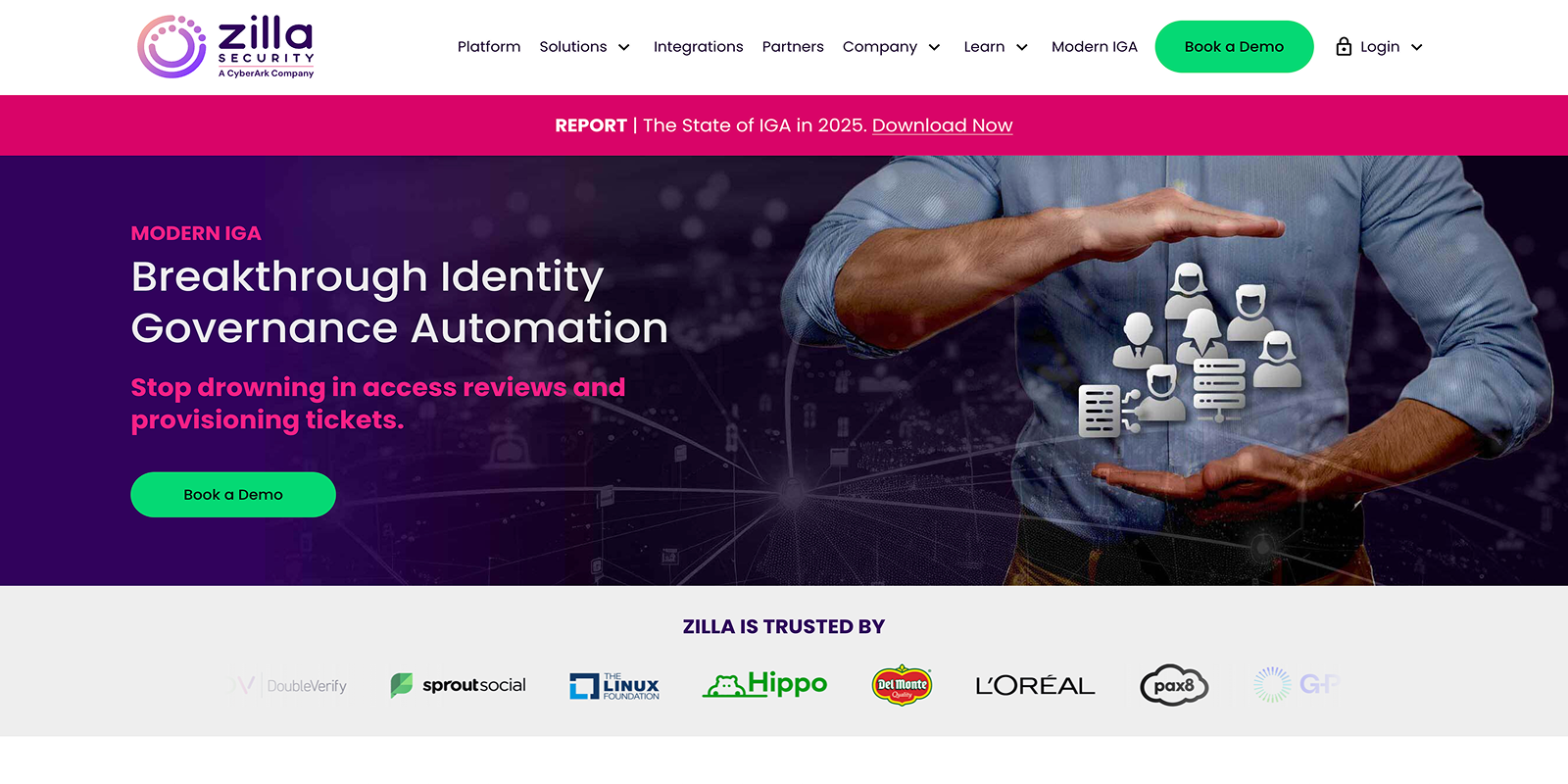
Zilla Security positions itself as a modern, AI-driven Identity Governance platform, designed to replace legacy IGA tools with faster deployment, automation, and improved usability. Zilla focuses on cloud-first environments, emphasizing AI-powered access reviews, role mining, and lifecycle governance with a strong user experience.

Zilla is often seen as a next-generation alternative to SailPoint, targeting organizations that want enterprise-grade governance without the traditional IGA implementation burden.

Strengths

  • Modern IGA UX: Clean, intuitive interface designed to reduce reviewer fatigue and improve adoption across business users.
  • AI-Powered Access Reviews: Uses machine learning to recommend access decisions, identify anomalies, and streamline certification campaigns.
  • Role Mining & RBAC Modernization: Strong capabilities around role discovery, role cleanup, and ongoing role governance—particularly attractive for organizations struggling with role sprawl.
  • Lifecycle Governance: Supports joiner–mover–leaver workflows with automated provisioning and deprovisioning tied to attributes and roles.
  • Faster Deployment Than Legacy IGA: Cloud-native architecture enables quicker time-to-value compared to traditional on-prem or hybrid IGA platforms.

Weaknesses

  • Less Risk Context Than Risk-First Platforms: While Zilla applies AI to recommendations, it is less focused on explaining entitlement risk or correlating toxic access across systems in the way risk-first IGA platforms do.
  • Primarily Human Identity–Focused: Non-human identity (NHI) and machine identity governance is less mature compared to newer identity security platforms.
  • Enterprise Pricing Without Transparency: Pricing is not publicly available and generally aligns with enterprise IGA budgets.
  • Limited Managed Services: Primarily a software platform; customers are expected to operate and optimize governance programs internally.

Ideal Customer

Mid-to-large enterprises that:

  • Are replacing legacy IGA tools like SailPoint
  • Need modern access reviews and role governance
  • Operate primarily in cloud and SaaS environments
  • Want faster deployment without rebuilding identity from scratch

Pricing

  • Quote-based pricing
  • Typically positioned for mid-market to enterprise customers
  • Costs scale based on identities, applications, and governance scope

Ready to simplify your access reviews and
strengthen your security posture?

Book a Demo with BalkanID today and see how effortless compliance can be.