Identity Federation: What It Is, How It Works, and Why It Matters for Modern Identity Architecture
Read this article
.svg)


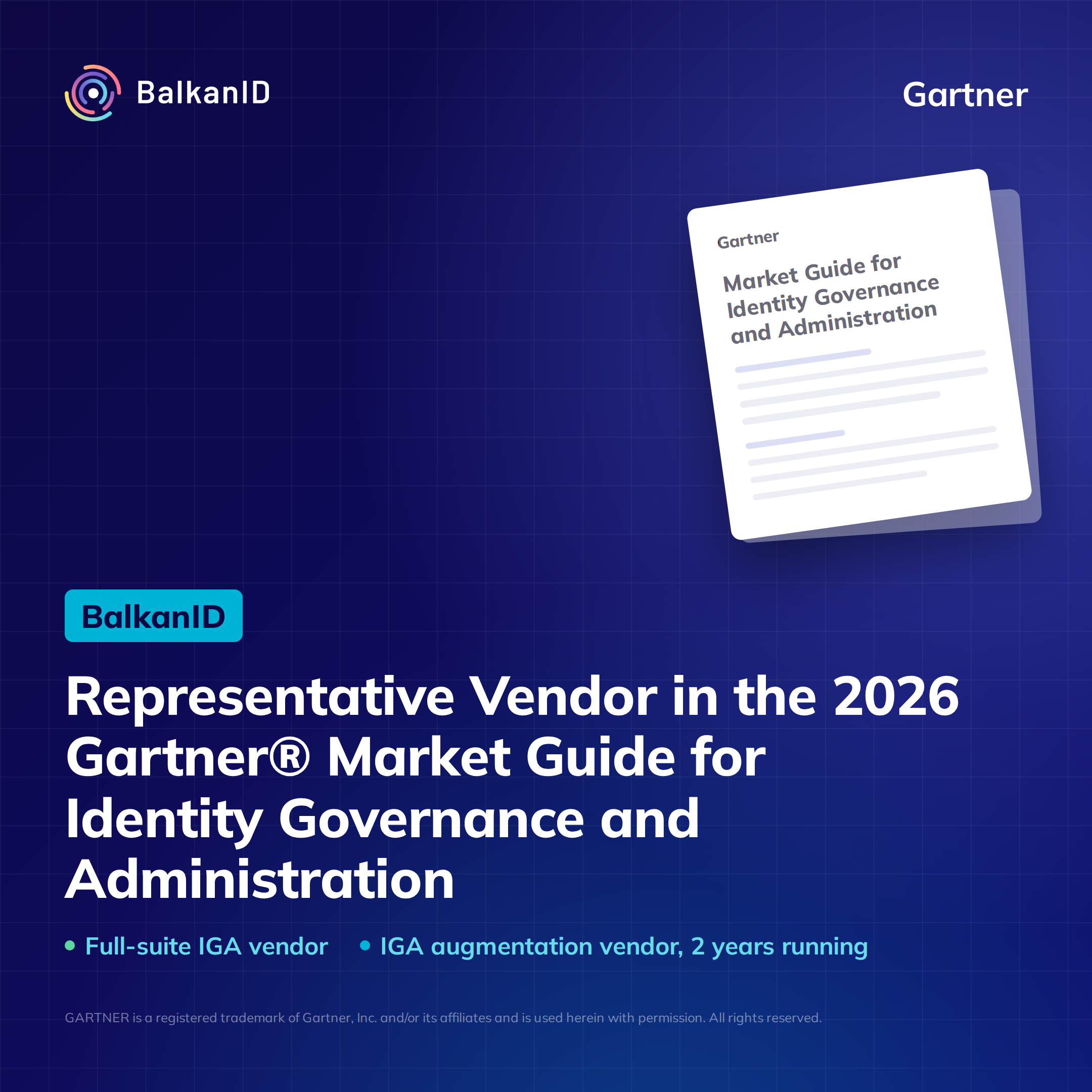
BalkanID is listed among full-suite IGA vendors in the Market Guide. Separately, Gartner Innovation Insight research continues to name BalkanID an IGA augmentation vendor for the second year in a row.

BalkanID is listed among full-suite IGA vendors in the Market Guide. Separately, Gartner Innovation Insight research continues to name BalkanID an IGA augmentation vendor for the second year in a row.
One-time, no-cost ISPM analysis gives security, IT and compliance leaders a unified, data driven view of IAM risk, RBAC effectiveness, AI and non human identity governance, and audit readiness across every major framework.
One-time, no-cost ISPM analysis gives security, IT and compliance leaders a unified, data driven view of IAM risk, RBAC effectiveness, AI and non human identity governance, and audit readiness across every major framework.



In today's interconnected digital landscape, the average employee juggles countless applications, each demanding its own set of credentials . This creates a state of fragmented access across different business units, partner organizations, and cloud services . In an era defined by SaaS proliferation, cloud computing, a flexible contractor workforce, and frequent mergers and acquisitions, this fragmentation isn't just an inconvenience—it's a significant operational and security challenge .
“Instead of creating a new account everywhere, what if users could log in once, with their own identity?”
This question leads directly to identity federation, a streamlined model that securely authenticates users across different organizational and application boundaries .
In simple terms, identity federation is a trust relationship established between two or more domains that allows a user to access services in one domain using credentials from another . It works much like using your Google or Apple account to sign into a third-party application without creating a new password .
Technically, identity federation is a system where authentication is delegated from a service provider to a trusted identity provider . This delegation is built on three key components :
The federated login process is designed to be seamless for the user while maintaining robust security. The flow typically unfolds in these steps :
These terms are often used interchangeably, but they represent different layers of identity management . Federation is the trust agreement that makes cross-domain access possible, while Single Sign-On (SSO) is the user-friendly experience of logging in once to access multiple apps .
In short: Federation is the trust model, SSO is the user experience, SAML/OIDC are the plumbing, and IAM is the entire house.
Adopting identity federation offers significant advantages:
While powerful, federation requires careful implementation:
BalkanID supports federated access across SAML and OIDC—giving your organization the ability to securely grant access to internal and external users, without compromising on least privilege or compliance.
Identity federation expertly solves the "who are you?" question (authentication), but it doesn't address the "what are you allowed to do?" question (authorization) . Just because a user is successfully authenticated doesn't mean they should have access to everything.
This is where identity governance becomes essential. You still need:
Identity federation gets users through the door—but governance ensures they are only in the right rooms.
In an increasingly collaborative and decentralized world, identity federation is a foundational pillar for secure, scalable identity architecture . As business ecosystems expand, it transitions from a "nice-to-have" feature to a fundamental requirement for modern IAM . By combining a robust federation strategy with a modern governance platform like BalkanID, organizations can achieve both seamless collaboration and airtight security at scale.
BalkanID is listed among full-suite IGA vendors in the Market Guide. Separately, Gartner Innovation Insight research continues to name BalkanID an IGA augmentation vendor for the second year in a row.
BalkanID is listed among full-suite IGA vendors in the Market Guide. Separately, Gartner Innovation Insight research continues to name BalkanID an IGA augmentation vendor for the second year in a row.
One-time, no-cost ISPM analysis gives security, IT and compliance leaders a unified, data driven view of IAM risk, RBAC effectiveness, AI and non human identity governance, and audit readiness across every major framework.
One-time, no-cost ISPM analysis gives security, IT and compliance leaders a unified, data driven view of IAM risk, RBAC effectiveness, AI and non human identity governance, and audit readiness across every major framework.